Many men may not love church, but Orthodox men do.
by Frederica Matthewes-Green
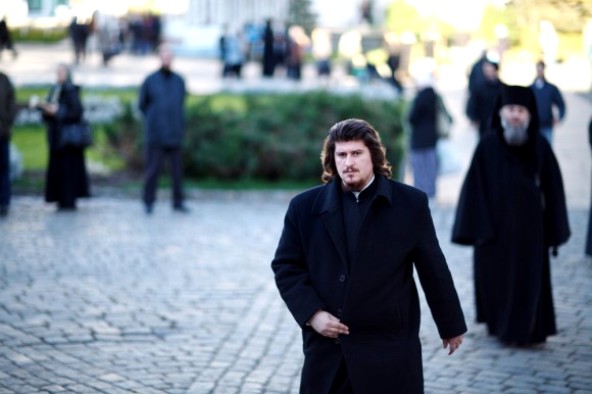
photo by MPDA.ru
In a time when churches of every description are faced with Vanishing Male Syndrome, men are showing up at Eastern Orthodox churches in numbers that, if not numerically impressive, are proportionately intriguing. This may be the only church which attracts and holds men in numbers equal to women. As Leon Podles wrote in his 1999 book, “The Church Impotent: The Feminization of Christianity,”
“The Orthodox are the only Christians who write basso profundo church music, or need to.”
Rather than guess why this is, I emailed a hundred Orthodox men, most of whom joined the Church as adults. What do they think makes this church particularly attractive to men? Their responses, below, may spark some ideas for leaders in other churches, who are looking for ways to keep guys in the church.
Challenges. The term most commonly cited by these men was
“challenging.”
Orthodoxy is
“active and not passive.”
“It’s the only church where you are required to adapt to it, rather than it adapting to you.”
“The longer you are in it, the more you realize it demands of you.”
The “sheer physicality of Orthodox worship” is part of the appeal. Regular days of fasting from meat and dairy, “standing for hours on end, performing prostrations, going without food and water [before communion]…When you get to the end you feel that you’ve faced down a challenge.”
“Orthodoxy appeals to a man’s desire for self-mastery through discipline.”
“In Orthodoxy, the theme of spiritual warfare is ubiquitous; saints, including female saints, are warriors. Warfare requires courage, fortitude, and heroism. We are called to be ‘strugglers’ against sin, to be ‘athletes’ as St. Paul says. And the prize is given to the victor. The fact that you must ‘struggle’ during worship by standing up throughout long services is itself a challenge men are willing to take up.”
A recent convert summed up,
“Orthodoxy is serious. It is difficult. It is demanding. It is about mercy, but it’s also about overcoming oneself. I am challenged in a deep way, not to ‘feel good about myself’ but to become holy. It is rigorous, and in that rigor I find liberation. And you know, so does my wife.”
Clear Disciplines. Several mentioned that they really appreciated having clarity about the content of these challenges and what they were supposed to do.
“Most guys feel a lot more comfortable when they know what’s expected of them.”
“Orthodoxy presents a reasonable set of boundaries.”
“It’s easier for guys to express themselves in worship if there are guidelines about how it’s supposed to work—especially when those guidelines are so simple and down-to-earth that you can just set out and start doing something.”
“The prayers the Church provides for us — morning prayers, evening prayers, prayers before and after meals, and so on — give men a way to engage in spirituality without feeling put on the spot, or worrying about looking stupid because they don’t know what to say.”
They appreciate learning clear-cut physical actions that are expected to form character and understanding.
“People begin learning immediately through ritual and symbolism, for example, by making the sign of the cross. This regimen of discipline makes one mindful of one’s relation to the Trinity, to the Church, and to everyone he meets.”
A Goal. Men also appreciate that this challenge has a goal: union with God. One said that in a previous church
“I didn’t feel I was getting anywhere in my spiritual life (or that there was anywhere to get to — I was already there, right?) But something, who knew what, was missing. Isn’t there SOMETHING I should be doing, Lord?”
Orthodoxy preserves and transmits ancient Christian wisdom about how to progress toward this union, which is called “theosis.” Every sacrament or spiritual exercise is designed to bring the person, body and soul, further into continual awareness of the presence of Christ within, and also within every other human being. As a cloth becomes saturated with dye by osmosis, we are saturated with God by theosis.
A catechumen wrote that he was finding icons helpful in resisting unwanted thoughts.
“If you just close your eyes to some visual temptation, there are plenty of stored images to cause problems. But if you surround yourself with icons, you have a choice of whether to look at something tempting or something holy.”
A priest writes,
“Men need a challenge, a goal, perhaps an adventure — in primitive terms, a hunt. Western Christianity has lost the ascetic, that is, the athletic aspect of Christian life. This was the purpose of monasticism, which arose in the East largely as a men’s movement. Women entered monastic life as well, and our ancient hymns still speak of women martyrs as showing ‘manly courage.’”
“Orthodoxy emphasizes DOING. …. Guys are ACTIVITY oriented.”
No Sentimentality. In “The Church Impotent,” cited above (and recommended by several of these men), Leon Podles offers a theory about how Western Christian piety became feminized. In the 12th-13th centuries a particularly tender, even erotic, strain of devotion arose, one which invited the individual believer to picture himself or herself (rather than the Church as a whole) as the Bride of Christ. “Bridal Mysticism” was enthusiastically adopted by devout women, and left an enduring stamp on Western Christianity. It understandably had less appeal for guys. For centuries in the West, men who chose the ministry have been stereotyped as effeminate. A life-long Orthodox layman says that, from the outside, Western Christianity strikes him as
“a love story written for women by women.”
The Eastern Church escaped Bridal Mysticism because the great split between East and West had already taken place. The men who wrote me expressed hearty dislike for what they perceive as a soft Western Jesus.
“American Christianity in the last two hundred years has been feminized. It presents Jesus as a friend, a lover, someone who ‘walks with me and talks with me.’ This is fine rapturous imagery for women who need a social life. Or it depicts Jesus whipped, dead on the cross. Neither is the type of Christ the typical male wants much to do with.”
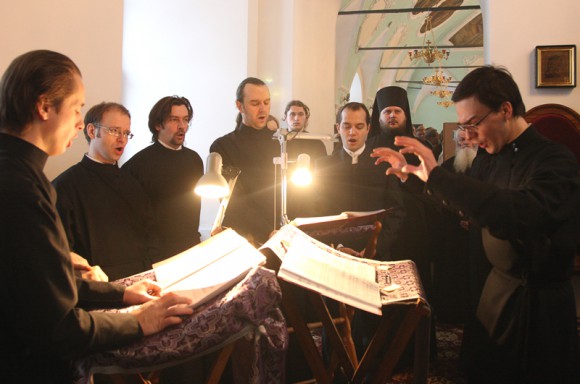
During worship,
“men don’t want to pray in the Western fashion with hands clasped, lips pressed together, and a facial expression of forced serenity.”
“It’s guys holding hands with other guys and singing campfire songs.”
“Lines about ‘reaching out for His embrace,’ ‘wanting to touch His face,’ while being ‘overwhelmed by the power of His love’—those are difficult songs for one man to sing to another Man.”
“A friend of mine told me that the first thing he does when he walks into a church is to look at the curtains. That tells him who is making the decisions in that church, and the type of Christian they want to attract.”
“Guys either want to be challenged to fight for a glorious and honorable cause, and get filthy dirty in the process, or to loaf in our recliners with plenty of beer, pizza, and football. But most churches want us to behave like orderly gentlemen, keeping our hands and mouths nice and clean.”
One man said that worship at his Pentecostal church had been
“largely an emotional experience. Feelings. Tears. Repeated rededication of one’s life to Christ, in large emotional group settings. Singing emotional songs, swaying hands aloft. Even Scripture reading was supposed to produce an emotional experience. I am basically a do-er, I want to do things, and not talk about or emote my way through them! As a business person I knew that nothing in business comes without effort, energy, and investment. Why would the spiritual life be any different?”
Another, who visited Catholic churches, says,
“They were conventional, easy, and modern, when my wife and I were looking for something traditional, hard, and counter-cultural, something ancient and martial.”
A catechumen says that at his non-denominational church
“worship was shallow, haphazard, cobbled together from whatever was most current; sometimes we’d stand, sometimes we’d sit, without much rhyme or reason to it. I got to thinking about how a stronger grounding in tradition would help. It infuriated me on my last Ash Wednesday that the priest delivered a homily about how the real meaning of Lent is to learn to love ourselves more. It forced me to realize how completely sick I was of bourgeois, feel-good American Christianity.”
A convert priest says that men are drawn to the dangerous element of Orthodoxy, which involves “the self-denial of a warrior, the terrifying risk of loving one’s enemies, the unknown frontiers to which a commitment to humility might call us. Lose any of those dangerous qualities and we become the ‘JoAnn Fabric Store’ of churches: nice colors and a very subdued clientele.”
“Men get pretty cynical when they sense someone’s attempting to manipulate their emotions, especially when it’s in the name of religion. They appreciate the objectivity of Orthodox worship. It’s not aimed at prompting religious feelings but at performing an objective duty.”
Yet there is something in Orthodoxy that offers
“a deep masculine romance. Do you understand what I mean by that? Most romance in our age is pink, but this is a romance of swords and gallantry.”
From a deacon:
“Evangelical churches call men to be passive and nice (think ‘Mr. Rogers’). Orthodox churches call men to be courageous and act (think ‘Braveheart’).
Jesus Christ. What draws men to Orthodoxy is not simply that it’s challenging or mysterious. What draws them is the Lord Jesus Christ. He is the center of everything the Church does or says.
In contrast to some other churches, “Orthodoxy offers a robust Jesus” (and even a robust Virgin Mary, for that matter, hailed in one hymn as “our Captain, Queen of War”). Several used the term “martial” or referred to Orthodoxy as the “Marine Corps” of Christianity. (The warfare is against self-destructive sin and the unseen spiritual powers, not other people, of course.)
One contrasted this “robust” quality with
“the feminized pictures of Jesus I grew up with. I’ve never had a male friend who would not have expended serious effort to avoid meeting someone who looked like that.” Though drawn to Jesus Christ as a teen, “I felt ashamed of this attraction, as if it were something a red-blooded American boy shouldn’t take that seriously, almost akin to playing with dolls.”
A priest writes:
“Christ in Orthodoxy is a militant, Jesus takes Hell captive. Orthodox Jesus came to cast fire on the earth. (Males can relate to this.) In Holy Baptism we pray for the newly-enlisted warriors of Christ, male and female, that they may ‘be kept ever warriors invincible.’”
After several years in Orthodoxy, one man found a service of Christmas carols in a Protestant church “shocking, even appalling.” Compared to the Orthodox hymns of Christ’s Nativity,
“‘the little Lord Jesus asleep on the hay’ has almost nothing to do with the Eternal Logos entering inexorably, silently yet heroically, into the fabric of created reality.”
Continuity. Many intellectually-inclined Orthodox converts began by reading Church history and the early Christian writers, and found it increasingly compelling. Eventually they faced the question of which of the two most ancient churches, the Roman Catholic or the Orthodox, makes the most convincing claim of being the original Church of the Apostles.
photo by Alexander Osokin
A lifelong Orthodox says that what men like is
“stability: Men find they can trust the Orthodox Church because of the consistent and continuous tradition of faith it has maintained over the centuries.”
A convert says,
“The Orthodox Church offers what others do not: continuity with the first followers of Christ.”
This is continuity, not archeology; the early church still exists, and you can join it.
“What drew me was Christ’s promises to the Church about the gates of hell not prevailing, and the Holy Spirit leading into all truth—and then seeing in Orthodoxy a unity of faith, worship, and doctrine with continuity throughout history.”
Another word for continuity is “tradition.” A catechumen writes that he had tried to learn everything necessary to interpret Scripture correctly, including ancient languages.
“I expected to dig my way down to the foundation and confirm everything I’d been taught. Instead, the further down I went, the weaker everything seemed. I realized I had only acquired the ability to manipulate the Bible to say pretty much anything I wanted it to. The only alternative to cynicism was tradition. If the Bible was meant to say anything, it was meant to say it within a community, with a tradition to guide the reading. In Orthodoxy I found what I was looking for.”
Men in Balance. A priest writes:
“There are only two models for men: be ‘manly’ and strong, rude, crude, macho, and probably abusive; or be sensitive, kind, repressed and wimpy. But in Orthodoxy, masculine is held together with feminine; it’s real and down to earth, ‘neither male nor female,’ but Christ who ‘unites things in heaven and things on earth.’”
Another priest comments that, if one spouse is originally more insistent about the family converting to Orthodoxy than the other,
“when both spouses are making confessions, over time they both become deepened and neither one is as dominant in the spiritual relationship.”
Men in Leadership. Like it or not, men simply prefer to be led by men. In Orthodoxy, lay women do everything lay men do, including preach, teach, and chair the parish council. But behind the iconostasis, around the altar, it’s all men. One respondent summarized what men like in Orthodoxy this way:
“Beards!”
“It’s the last place in the world men aren’t told they’re evil simply for being men.”
Instead of negativity, they are constantly surrounded by positive role models in the saints, in icons and in the daily round of hymns and stories about saints’ lives. This is another concrete element that men appreciate — there are other real human beings to look to, rather than a blur of ethereal terms.
“The glory of God is a man fully alive,”
said St. Irenaeus.
One writer adds that
“The best way to attract a man to the Orthodox Church is to show him an Orthodox man.”
But no secondary thing, no matter how good, can supplant first place.
“A dangerous life is not the goal. Christ is the goal. A free spirit is not the goal. Christ is the goal. He is the towering figure of history around whom all men and women will eventually gather, to whom every knee will bow, and whom every tongue will confess.”
HT: St. George Church of Prescott
Source: December 2007 issue of The Word magazine

In Christ there is no Jew or Gentile, East or West, male or female. While it is true that culture can influence it’s portrayal of Christ for better or for worse in the end Christ made himself all things to all people as St. Paul said of his own self. Christianity is a religion of paradoxes. Christ is both victim and high priest, shepherd and lamb, meek and humble yet glorious, strong, and royal. It is important for either West or East not to fall into the trap of either/or thinking but rather think more along the lines of both/and. Christianity can be watered down or overly “feminized” but deep down the Church as a mystery contains many ways for both men and women and people of all cultures and backgrounds to relate to God and yet remain in objective truth. God can be the one who “walks with me and talks with me” as a faithful “bridegroom” of the Church, but also a brother and warrior who comes to unite his disciples in mission against the evil one. It doesn’t have to be either/or. Thankfully, Eastern Catholicism has preserved both the Western and Eastern understandings of ancient Christianity. Just goes to show that when one is in communion with “The Rock” of Peter one has no doubt that he belongs to the great mystery that envelopes every diverse people of earth yet presents truth which cannot fall into subjectivism. Eastern Orthodox brethren understand continuity better than our Protestant brothers and sisters but Orthodoxy still remains marginalized so long as it fails to recognize the Bishop of Rome. I say this as an Eastern Catholic myself. Thank God that the holy mysteries such as the Eucharist have given Orthodoxy the great apostolic continuity it it does have. Let us pray we all be one so that the world my believe that Jesus was sent by the Father.
With respect and love in Christ,
Eastern Catholicism is just what it was invented to be – Catholics pretending to be Orthodox, and trying to convince everyone else that it is all the same.
Orthodoxy is not a “rite.” Eastern Catholicism is.
How you come to the conclusion that Orthodoxy is marginalized, unless you mean marginalized from Rome. We still await our Roman brothers return to the Orthodox faith, which is why there is no Orthodox bishop of Rome. The same cannot be said of Catholicism’s view of Orthodoxy, knowing that there is a Latin Patriarch of Jerusalem.
Orthodoxy has remained itself, while everyone else in the Christian world, including Rome, has gone to the charismatic movement, praise bands and every form of nonsense following the way of the world. I’m sorry to say it, but either you’re Orthodox or you’re not, and if you’re not…. you’re not.
You can, however, follow the path of a multitude of Eastern Catholics and enter the Orthodox Church. We welcome you home!
Forgive me for the criticism, but I’m ever concerned with the Orthodoxy’s obsession with itself. Trust me, I get all the stuff about being the most true to the early church. I’ve heard it, I’ve read it, I’ve heard it again.
Yet, just as the person who led me to this article in the first place mostly speaks of the rightness of the Orthodox over others, the primary concern of Orthodox brethren seems to be the validation of being in the Orthodox church. Take the name of this website for example: “Journey to Orthodoxy: For Those on the Path to the Orthodox Christian Faith.” Twice is a reference to our journey, not so much to God and/or Christ, but to MY church, MY denomination.
And here I thought our primary concern was Christ crucified and resurrected for our sins. For some reason, I find it very difficult to find the same self-obsession and church-preaching in the epistles of Paul. I do think that he talked about and pointed to Christ a lot, though….Weird.
This is not a criticism of Orthodoxy–I’m well aware of all the valid reasons you have “to boast.” This is a criticism of Orthodox members who have placed the pride of the tradition over the gospel message and Christ himself. And I must say, this is quite a growing majority. While certain criticisms of Protestantism and Catholicism are certainly valid, what I hear more than anything from the mouths of those in the Orthodoxy is, “You should be part of MY church; MY church is doing things right; look at US and OUR dedication to the true path,” instead of pointing to Jesus himself.
This doesn’t apply to everyone, and there is a fine line. But it is being crossed quite often. Of course, since the Orthodoxy is so right, who can challenge it?
Blessings.
Paul,
Thanks for writing. For many of us who had to wade through the mess that we were in, yes, Orthodoxy is a breath of fresh air – but in a particular way: Everything IS about Jesus Christ.
I do appreciate very much your criticism, but this site is dedicated to one thing and one thing only – helping seekers find the Bride of Christ, His Body. And, yes, we believe this is it, and other bodies are not. I’ve heard alot of things in Orthodox Churches, but I confess I’ve never heard anything even resembling your “quotation” (I’m assuming you are not actually quoting anyone, but your perception of a general attitude), and among some there is an immature, triumphal spirit.
But I ask you to consider this – if you knew that your Church WAS the Body of Christ, wouldn’t you do everything you could to bring others to her? What if they were convinced, like Mormons or Jehovah’s Witnesses, that they already are in the Church, that they already are Christians? What then? First things first – they must lovingly be made to realize that there is a true, ancient, and documentable (I know, it’s not really a word) Church which still exists, independent of scholastic, modern or other bizarre ideas.
Those who explore “Orthodoxy” or Orthodox Christianity soon discover that seeking something ‘more’ in Orthodoxy is like putting your mouth to a fire hose. More Christ, more devotion, more Scripture, more theology, more martyrdom, more witness – than ever before. All right under our noses in Orthodox Churches that don’t do much to make themselves known.
Again, please don’t misunderstand me. I deeply appreciate the sentiment of your criticism, but for those on the outside looking ‘in’ this is a journey. And more than anything else, inquirers want to know if anyone else, like them, is thinking what they are thinking, having done already what they are considering doing.
That is the purpose of Journey To Orthodoxy.
Finally – we love our Church! We want to make her known to others whenever and however we can!
Good Piece
So, do I understand correctly that you’re saying that the main reason that men are drawn to Orthodoxy is machismo?
Not machismo… manliness. There’s a difference, sadly not discerned by our over-Oprahfied culture.
Not sure why my comment didn’t get posted?
Too long and included links.
I didn’t think the comment was too long, especially since most of the comments so far have been rather long.
So, did you agree or disagree with the substance of the comment at all?
This post reminds me of a conversation I had a few years ago with an Orthodox monk, in which I mentioned – with a bit of trepidation – “wussy Jesus” as a description of the kind of Christ so prevalent in the West. To my great surprise and relief, he agreed! I don’t need somebody to schmooze with me, I need Somebody to save me, and the Christ in the Harrowing of Hades is Who I have in mind.
An interesting response to Kh. Frederica’s well-known article on men and Orthodoxy:
http://www.davidjdunn.com/2013/08/19/the-manliest-church-of-all/
Well, I come from a traditionally orthodox place and culture and there it’s mostly women that attend church. Just like everywhere else. I do not think the article has any basis in reality.
Ineteresting. Do you think that the convert’s children will embrace the faith as much as their Dad? The kids will be cradle born Orthodox now.
Mine have. It depends on the family and whether or not the children wish to follow Christ.
This article refers to Orthodox Christians in America – where Orthodoxy is in a language that is understood by most parishioners and visitors. I can’t speak for most other places as I don’t live there, but Orthodoxy has much to offer men AND women. The article does NOT say that Orthodox Churches would then have more men than women, simply that – unlike other forms of Christianity – the Orthodox faith and practices themselves are attractive to men seeking something more than an anemic Jesus.
Fr. John – I have found that in America as well, the large majority of people in the liturgy at any point are women. By the end of the service there end up being a lot of men who show up just for communion, but they are still far outnumbered by the women. And early in the service it is very sparse on the men’s side.
There are certainly a few single men that are attracted to become converts to Orthodoxy. But they stick out not because there are so many of them, but because there are so few converts in general. If we’re measuring what we’re doing well by the number or the type of the converts we attract, then we are certainly doing something wrong.
I am a retired evangelical minister. I have easily known dozens of Orthodox men in my 40 years of ministry experience, mostly Greeks. Sadly, I cannot think of one that I thought was a godly man. They were usually crude, vulgar, profane and blasphemous.They sometimes bragged about their church involvement, but I could observe no evidence of a life changed by the power of Christ.
A very common complaint by many outside of Christianity also. The reminder: Judge the medicine by those who take it, not by those who pour it down the drain.
Right?
I believe Orthodoxy in America is indeed a breath of fresh air. I grew up in Cyprus but only felt Orthodoxy in America because the orthodox church near by university made a real effort to reach out to everyone. It embraced and helped it’s small community. Extremely opposite almost all churches in Cyprus and Greece that take for granted their large following and make little effort to bring people closer to the church. In the US, the liturgy was in both Greek and English. There were pamphlets with the lyrics written so we could chant along. In Cyprus/Greece, its all in ancient Greek, which few understand and listen to. There are no pamphlets, and all people do is stand around and gossip. It’s sad. I wish the US model was copied here too….
Sophocles – sadly, that spectacle is true in many American churches as well. My wife’s church refuses to hold liturgy in anything other than Coptic and Arabic, even though the majority of church members have been here for decades and a good number were born here! Of the vibrant Orthodox communities I know, not a single one holds liturgy primarily in a language that many in the congregation do not understand.
In my mind language won’t solve anything, but it has to be a first step. There should still be home-language options for those whose heart language is not English, and perhaps a midweek liturgy in the ancient language, but our church life will continue to wither if we can’t fellowship together in a language we all understand.
With all of the criticism at this article, I think maybe some things are not understood as well as they can be. I can say that at least for me, they way I read it is that the reasons men stay/join Orthodoxy aren’t necessarily because they are trying to escape a feminized church as much as they are trying to establish/affirm/strengthen the male identity in a culture that’s lost any concept that the male even exists. I hope that makes some sense.
Despite my love of the Orthodox, my spirit is desperate for writings by female saints. It is a huge failing of Orthodoxy to only have writings by males. For all her history, the Orthodox church lags far behind her Roman Catholic sister in this category. There are virutally no role models for us females.
Theosisseeker, I can’t remember when I have heard such a blatantly ignorant statement about the Church. If your spirit is ‘desperate’ for the writings of female saints, may I suggest your spirit is desperate for all the wrong things, and certainly not Christian things. Be desperate for the Holy Spirit. Remember, Jesus didn’t write anything either. You probably don’t know what I’m talking about, but I’d like to help. I’m not sure what you’re really looking for but this should get you started:
Blessed Olga of Alaska
Blessed Mother Gavrilia
Seven Women Martyrs along with St. Irenarchus at Sebaste
St. Agatha of Belo-Russia
St. Agatha of Palermo
St. Agatha, St. Domna, and St. Theophila along with the 20,000 Martyrs of Nicomedia
St. Agathocleia
St. Aglaida (Aglae) of Rome
St. Agnes of Rome
St. Agnes, along with others, in the Crimea
St. Anastasia of Tessalonica
St. Anastasia the Patrician of Alexandria
St. Anastasia the Roman
St. Anastasia, the Deliverer from Potions
St. Angelina Brancovich, Princess of Serbia
St. Anna
St. Anna Vesvolodna
St. Anna at Adrianopolis
St. Anna of Constantinople
St. Anna of Novgorod
St. Anna, Holy Righteous Ancestor of God
St. Anna, Princess of Kashin
St. Anna, along with St. Thekla and Many Other Men and Women in Persia
St. Anna, the Prophetess
St. Anthusa at Rome
St. Antonina of Nicea
St. Anysia at Thessalonica
St. Apollinaria of Egypt
St. Apollonia of Alexandria
St. Apphia, and her husband, St. Philemon, of the Seventy
St. Apphia, the Martyr of the Seventy
St. Apphia, the wife of Philemon, and Equal of the Apostles
St. Aquilina
St. Argyre The Neomartyr
St. Ariadne of Phrygia
St. Asklepiodote of Adrianopolis
St. Athanasia and her daughters
St. Barbara of Heliopolis, Syria
St. Basilissa of Nicomedia
St. Basilla, at Rome
St. Bathildis, Nun of Chelles and Queen of France
St. Bebaia
St. Bebaia of Edessa with her brother
St. Bibiana (also known as St. Viviana) at Rome
St. Brigid of Ireland
St. Callinica and St. Basilissa of Rome
St. Callisthene and her father, Audactus of Ephesus
St. Cecilia at Rome
St. Chariessa, Nunechia, Basilissa and those martyred with them at Corinth
St. Charitina of Amisus
St. Christina in Persia
St. Christodoula The Mother Of Urban, Prilidian, Epolonius
St. Chryse (Zlata) of Bulgaria
St. Chryse of Rome and others
St. Claudia, along with Sts. Alexandra, Euphrasia, Matrona, Juliania, Euphmia and Theodosia
St. Cleopatra with her son, John
St. Crispina
St. Cyrenia in Cilicia
St. Daria and those with her at Rome
St. Deborah
St. Domna of Nicomedia
St. Domnica of Constantinople
St. Domnica of Syria
St. Domnina of Anazarbus
St. Domnina of Syria
St. Domnina with her daughters
St. Dorothy in Caesarea
St. Dorothy of Kashin
St. Drosis, the Daughter of Emperor Trajan
St. Edburga of Minster-in-Thanet
St. Elfleda, Abbess of Whitby
St. Elizabeth, Mother of St. John the Baptist
St. Emerentiana of Rome
St. Emilia, Mother of Sts. Basil and Gregory
St. Ennatha, St. Valentina and St. Paula, Virgins and Martyrs
St. Ephigenia of Ethiopia
St. Epicharis of Rome
St. Epistime with her husband, Galacteon, at Emesa
St. Erkengota, Virgin of Faremoutier-en-Brie
St. Ermenhilda, Abbess of Ely Monastery, England
St. Ethelburga
St. Euanthia with Her Husband and Son, at Skepsis
St. Euboula, the Mother of St. Panteleimon
St. Eudokia Martyr of Heliopolis
St. Eudokia of Heliopolis
St. Eugenia at Rome
St. Eulampia and her brother, Eulampius
St. Euphemia the All-Praised
St. Euphrasia of Nicomedia
St. Euphrosyne of Alexandria
St. Euphrosyne of Suzdal
St. Eupraxia the Elder
St. Eupraxia, Princess of Pskov
St. Eustolia of Constantinople
St. Euthalia of Syria
St. Eutropia of Alexandria
St. Evanthia with her son, St. Eleutherius
St. Fausta at Cyzicus, along with Sts. Evilasius and Maximus
St. Felicitas of Rome and her Seven Sons
St. Gaatha, the Queen, along with others, in the Crimea
St. Gaiana of Armenia
St. Galina and those with her at Corinth
St. Genevieve of Paris
St. Gertrude, Abbess of Nijvel Monastery
St. Gobnata at Ballyvourney
St. Gorgonia, sister of St. Gregory the Theologian
St. Hannah, Mother of the Prophet Samuel
St. Helen at Sinope
St. Helen of Serbia
St. Helen’s Uncovering of the Precious Cross and Precious Nails in Jerusalem
St. Hermione the Daughter of St. Philip the Deacon
St. Hilaria and those with her at Rome
St. Hilda, Abbess of Whitby
St. Ia, Virgin of St. Ives
St. Inna, St. Pinna and St. Rimma, Martyrs and Apostles of St. Andrew
St. Irais (Rhais) of Alexandria the Apostle at Heraclea
St. Irais (Rhais) of Antinoe in Egypt
St. Irene Myrtidiotissa
St. Irene The Great Martyr of Thessaloniki
St. Ita, the Hermitess of Killeady
St. Judith
St. Juliana and her brother, Paul
St. Juliana at Heliopolis, in Syria
St. Juliana of Lazarevo
St. Juliana of Nicomedia
St. Juliana, Blessed Virgin Princess of Olshansk
St. Juliana, Princess of Vyazma
St. Justina of Nicomedia
St. Karina with her husband and son
St. Kassiane
St. Katherine of Alexandria
St. Kentigerna, Hermitess of Loch Lomond
St. Ketevan, Queen of Kakheti
St. Kew, Virgin of Cornwall
St. Kyra of Syria
St. Kyriake of Rome
St. Larissa, the laywoman, along with others, in the Crimea
St. Leonilla and St. Jonilla at Cappadocia
St. Lucy of Syracuse
St. Ludmilla, the Grandmother of St. Wenceslaus
St. Lydia Alexandrova, along with her husband, mother and three daughters
St. Lydia in Illyria
St. Marana of Syria
St. Maria of Alexandria
St. Maria of Constantinople, along with her husband and sons
St. Maria of Gatchina, Matushka and New Martyr
St. Maria, Schema Nun and Mother of St. Sergius of Radonezh
St. Maria, the Mother of the Venerable Sergius of Radonezh
St. Maria, the Niece of Abramius, the Recluse of Mesopotamia
St. Mariamne, Sister of Apostle Philip
St. Martha and St. Mary, in Egypt
St. Martha the Mother of St. Simeon Stylite the Younger
St. Mastridia of Alexandria
St. Matrona of Chios
St. Matrona of Thessalonica
St. Matrona, Abbess of Constantinople
St. Maura of Constantinople
St. Maxima of Singidunum, and her priest-husband, St. Montanus
St. Melitina of Marcianopolis
St. Melitsa of Serbia
St. Memelchtha of Persia
St. Menodora, St. Nymphodora, and St. Metrodora
St. Merwinna, Abbess of Romsey, Hampshire, England
St. Mianus (Ammianus) of Nicomedia
St. Mildgyth of Minster
St. Miriam
St. Myrope at Chios
St. Nana, Empress of Georgia, and Equal of the Apostles
St. Neonilla with her husband and children
St. Nino, Equal of the Apostles and Enlightener of Georgia
St. Paraskeva (Petka) of Serbia
St. Paula of Rome
St. Pelagia of Tarsus
St. Pelagia the Penitent
St. Perpetua, St. Felicitas, and those with them, at Carthage
St. Philothea the Monastic
St. Philothea, the Protectress of Romania
St. Phoebe the Deaconess at Cenchreae near Corinth
St. Photini, the Samaritan Woman
St. Piama of Egypt
St. Prisca of Rome
St. Priscilla, with her husband, Aquila, at Ephesus
St. Publia the Confessor and Deaconess of Antioch
St. Rebecca
St. Rhipsime of Armenia
St. Rufina of Caesarea
St. Sabina of Smyrna, along with Sts. Pionius and Limnus
St. Salome and St. Perozhavra of Ojarma
St. Sarah
St. Sarbelus of Edessa
St. Scholastica, Sister of St. Benedict of Nursia
St. Sebastiana the Martyr and Disciple of St. Paul the Apostle at Heraclea
St. Sidonia Of Georgia
St. Sopatra of Constantinople
St. Sophia and Her Three Daughters
St. Sophia of Suzdal
St. Sophia the Mother of Orphans
St. Susanna in Palestine
St. Syncletica of Alexandria
St. Syncletica with her two daughters
St. Tabitha the Widow, Raised from the Dead by the Apostle Peter
St. Tatiana of Rome, and Those Who Suffered With Her
St. Thais of Egypt
St. Thekla and Many Others who Suffered in Persia
St. Thekla, Protomartyr and Equal to the Apostles
St. Theoctiste of the Isle of Lesbos
St. Theodora
St. Theodora of Alexandria
St. Theodora of Caesarea
St. Theodora, Wife of Emperor Theophilus the Iconoclast
St. Theodota at Nicea
St. Theodota in Egypt
St. Theodota the Mother of the Unmercenaries Cosmas and Damian
St. Theodota, who suffered under Diocletian
St. Theodula of Anazarbus in Cilicia
St. Theophano, Empress of Byzantium
St. Theopiste with Her Husband and Children
St. Theosebia, Sister of St. Basil and St. Gregory
St. Tryphaina at Cyzicus
St. Vassa and Her Children
St. Wendreda, Hermitess of March, Cambridgeshire, England
St. Werburga, Abbess of Canterbury
St. Winefride
St. Xanthippe and St. Polyxene, Disciples of the Apostles
St. Xenia
St. Xenia of Rome
St. Xenia of St. Petersburg
St. Zenaida of Tarsus
St. Zenobia of Aegae, and her brother Heiromartyr Zenobius
St. Zoe
St. Zoe at Rome
and of course, the greatest saint of all – the Theotokos and Ever-Virgin Mary.
That took me less than a minute to find, and I’m sure it is only a fraction of women saints.
If you can’t find a role model in there, you are looking for the wrong role model.
Not sure if this is still checked or not… but i have to say this perfectly sums up my reason for wanting to convert, with this i can show my parents why i want to and have them stop thinking i am part of a cult or something. This is a great list and many thanks and blessings to those who compiled it.
Adryan, yes it is still kept up to date.
Let us know how we can assist you. You’re on a well worn path and we are ready to help.
What I dislike most about Orthodoxy is it makes me look inward, self examine, and change. What I like most about Orthodoxy is it makes me look inward, self examine, and change.
The Kingdom of God is within you!
This is an interesting article. I am Catholic, but have a deep respect for Orthodoxy and long for the day that the rift between us can be healed.
MarylandBill, we feel the same way, and long for a reunion of Truth and Love!
I grew up protestant (freewill Baptist/ evangelical) and this article resonates with me on a deep level. The way that emotion dominated church services always made me feel a little uncomfortable. There seemed to be almost a lack of seriousness involved; a “go with flow” type of mentality that struck me as lacking in tradition and substance. The way Christ was portrayed in a sense as weak, effeminate, pacifist, and a man of non-action didn’t make sense to me at all for some reason despite that being the archetype I was taught. The end result wasn’t that I accepted the feminized version of Christ, but that I stopped going to church all together. I thought that my views on Christianity weren’t accepted by any mainstream church because they were “traditional”, “old fashioned”, or “outdated”. I must say that for a few years I was completely disillusioned with modern Christianity, I felt that there was no place within it for me despite being a Christian and trying to live up to that as best I knew how. From what I’ve read on the orthodox church it seems to be the only form of Christianity in the world that truly makes sense to me. I plan on converting within the next year. I’m 20 years old. I’ve read about or tried every form of Christianity in America. It is the only one with a real tradition. It doesn’t tell me that “feel good feelings” are a basis for the whole religion. It is the only one that doesn’t portray Christ in a weak or effeminate manner. It doesn’t change with the latest fashion or trend. God bless Orthodox Christianity.
Joe, welcome home. Let us know how we can help you.
Fr. ,The evangelical pastor’s claim of numerous ungodly Orthodox men (mostly Greek as he put it) is unfounded. Just how many of these alleged men over his 40 years ministry fit this narrative? 20? 50? 100? I doubt it! Such men were not committed to their faith, or were disconnected while being catechized! And for the others claims of no men in Orthodox churches in other countries? Not what I’ve seen, nor heard. I go an Antiochian parish full of family men who immigrated from the Mideast and are cradle Orthodox. We also have Romanian and Ukrainian family men who immigrated to America and are deeply involved in the sacramental life of the church too. These claims usually come from EE atheist and libertine men with an axe to grind with the Orthodox Church, just as they come from atheist and libertine American men. As to men showing up late for communion, we have that problem, but our Abouna forbids them from taking the gifts. I serve at altar as an Acolyte in Minor Orders, so I’ve seen and heard him speak openly and directly to the congregation about this. And further, to the evangelical pastor’s claim, as a former evangelical who converted to the EOC 20 years ago at the then age of 40, and who found evangelical Protestantism to be “an inch deep, and a mile wide”, I could write a book on the vast number (yes 100s) of ungodly and hateful evangelical men and women, including clergy, with a false sense of piety, that I’ve encountered in my 60 years of life. This is one of the many reasons for my journey into the ancient church of Peter and Paul. Added to these reasons, was also the rampant feminization of western churches.
Greetings
I stumbled upon this article today, and having read it several times I find it odd. I am new to Eastern Orthodoxy, in truth I am brand new, so my reply may be a bit skewed.
As a man of 55, a US Army veteran, a Firearms and Tactics instructor, as well as a martial combatives instructor I find this presumption of manliness askew. I have met very few Christians, Orthodox included who had the physical ability or drive to deal with violence in a physical realm let alone a spiritual realm. In fact I see very few who are physically fit enough to last a minute in violence.
I understand that the text book Christian answer no matter denomination is peace, and love thy neighbor, forgive thine enemies etc. but in my experiences, over a long life involved in careers that dealt with violence one had better be able to deal with the physical threats in a secular world as much as in the spiritual ( because physical demons don’t give a tinkers damn about you!) And in my eyes that is rare find in any Christianity.
Pastors, Priests, and Elders talk about the body is a temple, yet they cannot see their feet, they talk of spiritual warfare yet they cannot back their beliefs when true, secular evil comes knocking. This to me is as a huge problem.
The Orthodox Knights (Turcopolse) were fierce warriors in the Crusades. They protected the people in the Outremer societies of the Holy Land, they were physical men with abilities to deal with true physical violence at the sake of their souls. It seems that part of the path is forgotten and spurned nowadays, sadly! And in my opinion the Crusades are back.
As I said I am new to Eastern Orthodoxy yet there is something that pulls me to it. Yet the contradictions on this subject alone causes yet a further struggle. I will not discontinue training, or teaching good people the ways of self protection, I will not be some turn the cheek Martyr this taking me from my child, I will not let innocent people get slaughtered when I know I can do something about it. Those things are sinful.
And if it means Orthodoxy refuses me or castes me as a Heretic than so be it. But I will not base my manhood on walking into a church and feeling as if I’m some spiritual warrior. That is a cop out to the true battles that hunt Christianity. Look around you, they want the laity’s heads, and any sign of Christianity gone from this world.
The battles start here !! Mix in some push-ups and learn the ways of earthly battle. Orthodox Christianity and Being a warrior on earth go together!
IXCX
Draconistarium, thanks for your service, and the sacrifices you’ve made serving our nation. As you said, you are new to Orthodoxy, and your understanding of manhood is at least slightly skewed. While there are many clergy who ‘cannot see their feet’ there are just as many who are serious ascetics, and many serious athletes (marathon runners, weight lifters, power lifters, and more).
As for being physically fit enough to last in a violent encounter, I will have to poll the firefighters, deputies, police detectives, construction workers, etc who frequent our parishes. In my experience, violent encounters don’t last long. Anyway, being a man isn’t about being fighting fit, it’s about standing in the breach, and while physical fitness does help, it is interior strength and willpower that makes it possible to stand against the world, and against adversaries, without which physical fitness is useless. The gym I frequent is filled with many men who are ‘fighting fit’ but are so weak on the inside that it is clear they are muscle building to compensate for their insecurities – almost to a man. Forget push ups, try prostrations – they’re a little like burpees, only you do more of them every day.
As for me, I’m always up for a challenge, so I’ll just put this here:

Father is absolutely correct. I’m surprised this recent convert to Orthodoxy has missed this. What I see out there is this so called “Manosphere”, “Red Pill”, “MGTOW” , “Men’s Rights Movement” that espouses this line of thinking. I know personally the extreme animus they harbor towards older men (I’m 61), and men of faith, in these groups. While their push back to feminism, family courts that are clearly anti-male/fathers, and SJW shenanigans is warranted, the deep solipsism, callous incivility, animus towards the sanctity of marriage, slothful work ethic, obsession with gyms and body image (seems rather feminized to me), and a lack of any faith base and/or moral compass is a sad reflection of what defines many men I interact with daily in our culture.
mmn, not sure obsession with gyms and body image is “feminized” behaviour, historically classic narcissism has always been a male vice rather than a female one. However, keep up with the self-congratulatory posts on masculinity… and don’t spare the beard oil boys!
Two words, Flo: Beauty industry.
Currently the beauty industry is worth over $500 billion, soon to be an $800 billion industry.
Beard oil, on the other hand, can’t even muster $4 billion.
When it comes to narcissism, equality ain’t a thing.
To the naysayers, I am a practicing pagan and am considering attending either Vespers or Divine Liturgy this weekend. Possibly conversion.
And I can tell you 100% that the issues pointed out in this article were a major contributor as to why I left christianity in the first place.
Great article.
Let us know how we can help, Sam! Also, start with Vespers. You can thank me later. 😉
Haha thank you Fr. John. I may return here with more questions if that is alright.
Is this the best way to correspond?
Sam, I gotta say. last time I commented here I was barely a catechumen. But this is a Decision you won’t regret, with study, and time to digest it all, (It’s all overwhelming at first) I think with a sincere yearning for truth, an open mind you will find a way home. I am baptized now, and much has happened to me since I last commented here, and I am finally putting my life back together thanks to Orthodoxy. A priest should always be your go to for theology and often as a good example of faith, both prayerful and in-action, but myself, and many others are here to help if you are interested, even if it’s just to talk. May God’s light guide you to truth, and may he bless you throughout your journey.
~With Love in Christ and from a man made new,
Adryan Malatesta
Also for Draconistarum, Read about the prison saints, Of Russia, Romania, (Some held in nazi camps in or near germany), throughout the soviet union before, during, and after the war. These men and women (although I know this article is male focus, some were women martyrs as well.) suffered such unimaginable cruelty, and yet held firm to the faith, something that takes sheer internal willpower as Fr John noted. Body building wouldn’t have helped any of them in the slightest, my own great grandfather was in dachau, and he survived, he was 88 pounds when he escaped. not 200+ and full of muscles, his faith saved him, nothing else. anyway, God bless
Very interesting story and keep it strong in choosing the path. As it comes from its name, being an “Orthodox” is definitely not something easy. But truly fruitful.
God bless. Pavel